
Foundation models
Organize unstructured research and support real-time health decisions during long-duration missions.
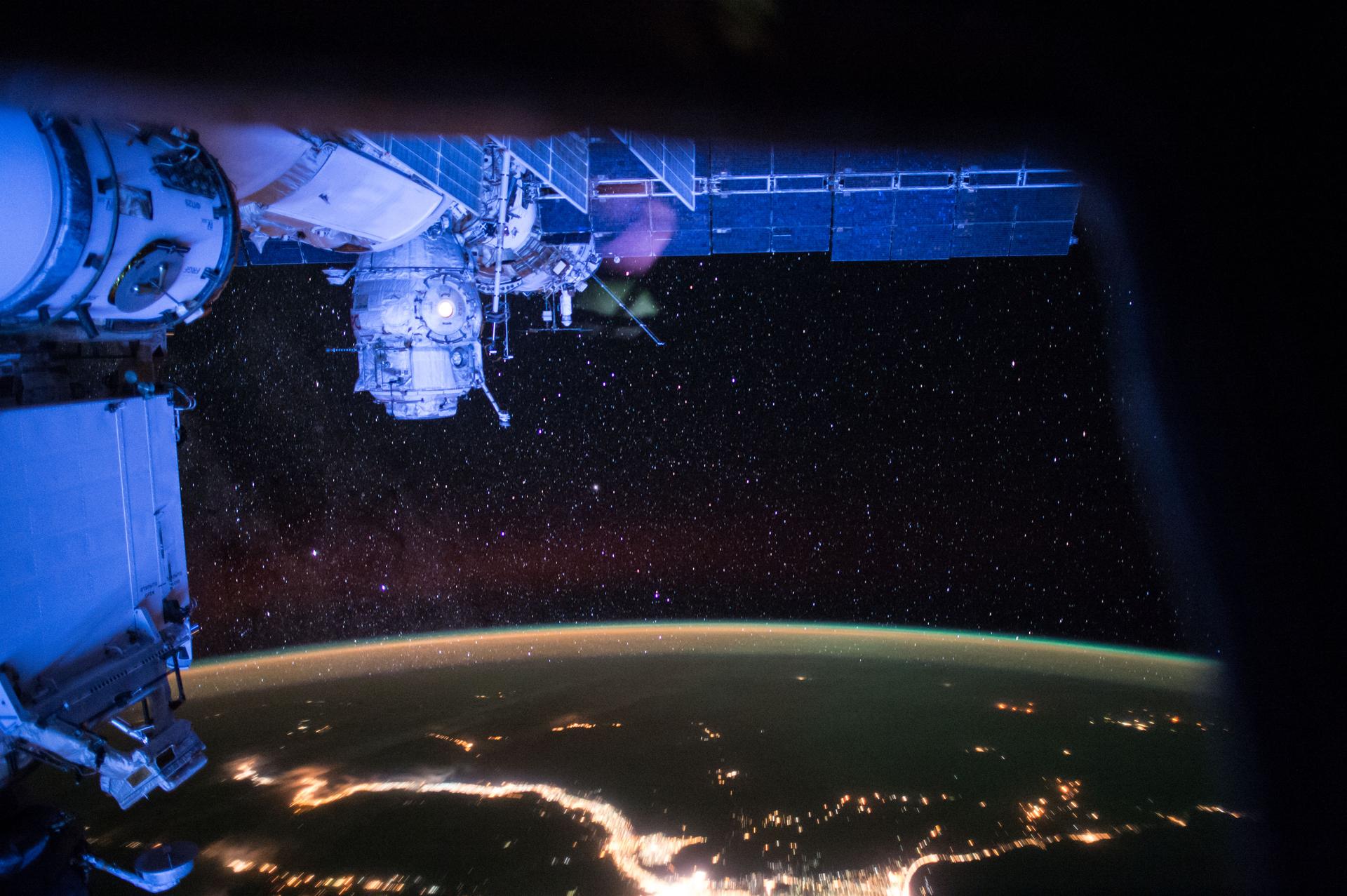
Turning space biology data into insight, so crews can travel farther and live healthier on Earth and beyond.
The Computational Space Biology Lab builds computational frameworks that use machine learning and artificial intelligence to model, predict, and help mitigate the risks of spaceflight.
We develop tools to make complex biology more understandable, predictive, and useful for the people planning future missions.
Organize unstructured research and support real-time health decisions during long-duration missions.
Model how biological systems respond to spaceflight stressors and explore precision interventions.
Identify relationships in complex biological systems to improve prediction and risk mitigation.
Bring diverse NASA Open Science Data Repository datasets together for richer analysis.
Train models across separated datasets while reducing data movement and respecting privacy.
Connect biological evidence across data sources to reveal patterns relevant to crew health.
Methods, datasets, and collaborations advancing AI/ML for space biology.
Graph-based explainable AI connects gene expression, proteins, methylation, and calcium uptake in spaceflown mouse muscle.
Read the studyThe CRISP ensemble identifies genes potentially causal of increased liver fat in spaceflown mice, with work expanding to bio-imagery.
Read the studyGuided Transfer Learning uses inductive biases to help models learn effectively in high-dimensional, low-sample-size space biology.
Explore the preprintA federated approach trains predictive models across physically separated nodes, including data on the International Space Station.
Read the preprintNASA GeneLab and the SPOKE biomedical knowledge graph help link spaceflight biology to physiological changes and symptoms.
Read the studyA seminar series bringing researchers together to discuss emerging methods, data, and interdisciplinary discoveries.
Explore the seriesGenerative adversarial networks amplify signal in small space biology datasets using synthetic RNA sequencing data.
Read the paperA standardized, AI-ready dataset for model benchmarking, training, and community data challenges.
Access the datasetA standardized fluorescence microscopy dataset, supported by NASA, for AI/ML benchmarking and research challenges.
Access the datasetOpen-source, no-cost virtual training in AI/ML for space biology, designed with no prerequisites.
Enroll in the courseThe Computational Space Biology Lab brings together expertise in machine learning, biology, biomedical research, and spaceflight. Connect with the team or join the open science community.
Recent publications and preprints from Computational Space Biology Lab collaborators.
Machine Learning Ensemble Investigates Age in the Transcriptomic Response to Spaceflight in Murine Mammary Tissue: Observational Study. JMIRx Bio.
↗Bridging Earth and Space: A Flexible and Resilient Federated Learning Framework Deployed on the International Space Station. bioRxiv.
↗Analyzing the relationship between gene expression and phenotype in space-flown mice using a causal inference machine learning ensemble. Scientific Reports.
↗Explainable machine learning identifies multi-omics signatures of muscle response to spaceflight in mice. npj Microgravity.
↗